
Why Climb with Granite Arches?
 Experience

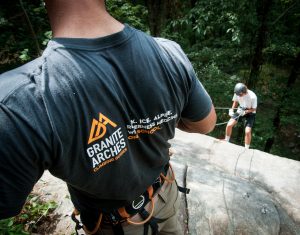
In 1996, long before the big guiding outfits in the southeast, one small climbing school was quietly educating the next generation of climbers, guides, and wilderness medicine specialists. That company was Granite Arches Climbing Guides. Now with over 20 years experience in climber education, and an average guide age of 40+, Granite Arches is better than ever and has continued to develop its cutting edge curriculum and courses. Granite Arches has intentionally remained an intimate, boutique guiding company whose guides are focused on YOU and YOUR GOALS, not OUR accomplishments. We are all about helping you reach your rock and ice climbing, rescue, and wilderness medicine goals as quickly as possible.

Service
Selecting a guide or guide service is an important decision. Granite Arches strives to provide three things:
1) Expert Instruction from a Qualified Guide
Expert instruction means that when you climb with Granite Arches, you are climbing with a terrific instructor that has ample experience to help you learn and to help manage the risks of climbing. See our guide page for info on our guides.
2) All Necessary Equipment
This includes ropes, harness, helmet and other necessities. Non-essential gear (climbing shoes) can be rented for a nominal fee.
3) Exceptional Service
Granite Arches provides personal service before, during, and after the climb. Before the climb, we try hard to make guiding arrangements easy with online form downloads, credit card and electronic payment systems, and cell phone contact options. During the climb, we provide exceptional guiding and instruction (see above), and record the progress of each client for future reference. After the climb, we stay in touch with our clients and are available to answer questions on everything from technical systems to climbing equipment purchases.
 Our People

In the end, your climbing guide is only as capable as his/her teaching, communication, guide training and personal climbing experience allow. Our well-rounded climbing guides have many certifications, but more than anything they are great teachers. All of our guides are at least 27 years of age, are active climbers with years of climbing and guiding experience to share. You can read more our guides on the guide page.
 Our Training

Our guides train under the umbrella of the AMGA (American Mountain Guides Association) and various professional teaching organizations. The AMGA examination process is the oldest and most respected benchmark for professional guides' technical proficiency in the United States, and indicates a high level of technical and practical proficiency. Perhaps more importantly, it indicates a commitment to self-critique, client care and continuing professional development. All of Granite Arches guides have been trained and certified by the AMGA to work on various types of climbing terrain. See the guides page for more information about our guides.

Why Hire a Climbing Guide?
Climbing rock efficiently requires a high level of proficiency with numerous technical systems, a strong suite of physical skills, and a host of decision-making capabilities. Climbing with a competent guide can help you jump quickly to the next level of technical knowledge, physical technique, and risk management. Below are some specific reasons that climbers with different experience levels can benefit from guided instruction and/or guided climbing
Many beginner climbers hire guides to teach them the rudiments of climbing and get them started correctly with solid climbing technique as well as proven technical systems and skills. This is an excellent way to learn accepted modern techniques of climbing and to begin to competently manage the risks of some components of your personal climbing. Additionally, climbing with a guide can help you quickly gain enough knowledge to evaluate the climbing systems of other more experienced climbers that you depend on for your safety as you start climbing.
Intermediate climbers have usually begun to build natural or artificial anchors and/or have begun lead climbing. With the increased technical demands of anchor construction and lead climbing come greater problems of risk management but also greater opportunities for proper application of relevant and timely systems. Working with a professional on anchor construction is a wise idea, and seminars on leading psychology, zipper analysis, directional rope systems, double rope technique, single point anchor analysis, and/or mock leads are often helpful.
Arguably advanced and more experienced climbers have more to gain from climbing with a guide than other individuals. Advanced climbers are often the lead climbers in small groups of climbers, or on multi-pitch group climbs. As a leader taking others on multi-pitch terrain, a competent guide can help you further develop or fine-tune your decision making, anchor building, climbing psychology, anchor placement and design, and rope/station management skills. Finally, all climbers--and certainly all intermediate and advanced climbers-- should be well versed in self-rescue. Multi-pitch terrain requires a much more thorough understanding and application of rescue techniques. At the intermediate and advanced level, you should be able to raise or lower a second climber, rescue a leader, quickly perform knot passes, 3, 5, and 7:1 raises, counterbalance rappels and tandem 'pick-off' rappels. A competent guide can help you quickly develop your rescue skills by providing instruction in a controlled environment.